












August 6, 2026
Elsyca LeakageMaster Adds Faster Solver, Narrow Path Detection, and Virtual Smoke Visualization for Acoustic Leak Analysis
New release cuts solver run times up to fourfold, adds a single metric for sealing performance, and lets engineers see leak paths without a physical smoke test.
WIJGMAAL (LEUVEN), Belgium, July 30, 2026 — Elsyca, a provider of electrochemical and acoustic simulation software for the automotive industry, today announced a set of updates to LeakageMaster, its tool for identifying acoustic leakage paths in a Body-in-White. The release comes as the shift to electric vehicles removes the engine noise that once masked minor acoustic leaks, making small apertures and structure-borne noise paths far more noticeable to drivers and passengers. LeakageMaster addresses this by letting acoustic engineers find leakage paths, generate and manipulate plugs, and verify the effect of design changes directly on CAD data, without needing a physical prototype for a smoke test.
A Faster, More Targeted Solver
At the core of the release is a reworked solver that targets only the leakage paths engineers care about. Rather than tying results to a fixed mesh input, the new solver filters by a tolerance the user sets, a minimum hole size, and ignores minor geometry artifacts that previously produced duplicate or phantom paths. On an industrial benchmark, this brought run times down by a factor of four and memory use by half, while returning results that match the chosen tolerance and require less manual clean-up.
Introducing Narrow Paths
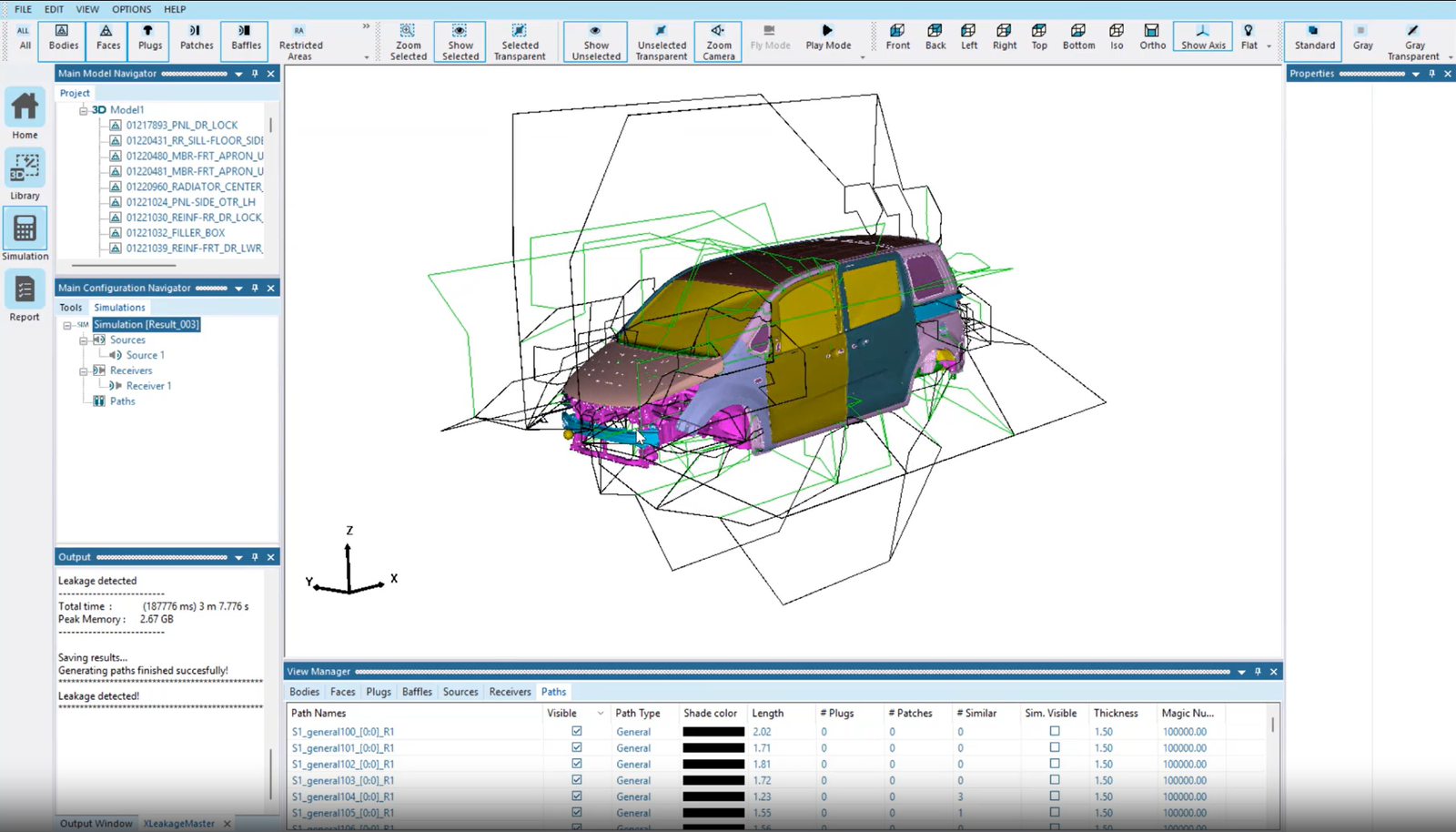
Openings smaller than the chosen resolution are now flagged as their own "Narrow" path type, with a toggle to isolate and review them. Because the new solver filters out sub-resolution openings to gain speed, this gives engineers a way to check what was filtered rather than take it on faith, keeping the lighter solver's performance without losing visibility into borderline cases.
Introducing Intersected Plugs
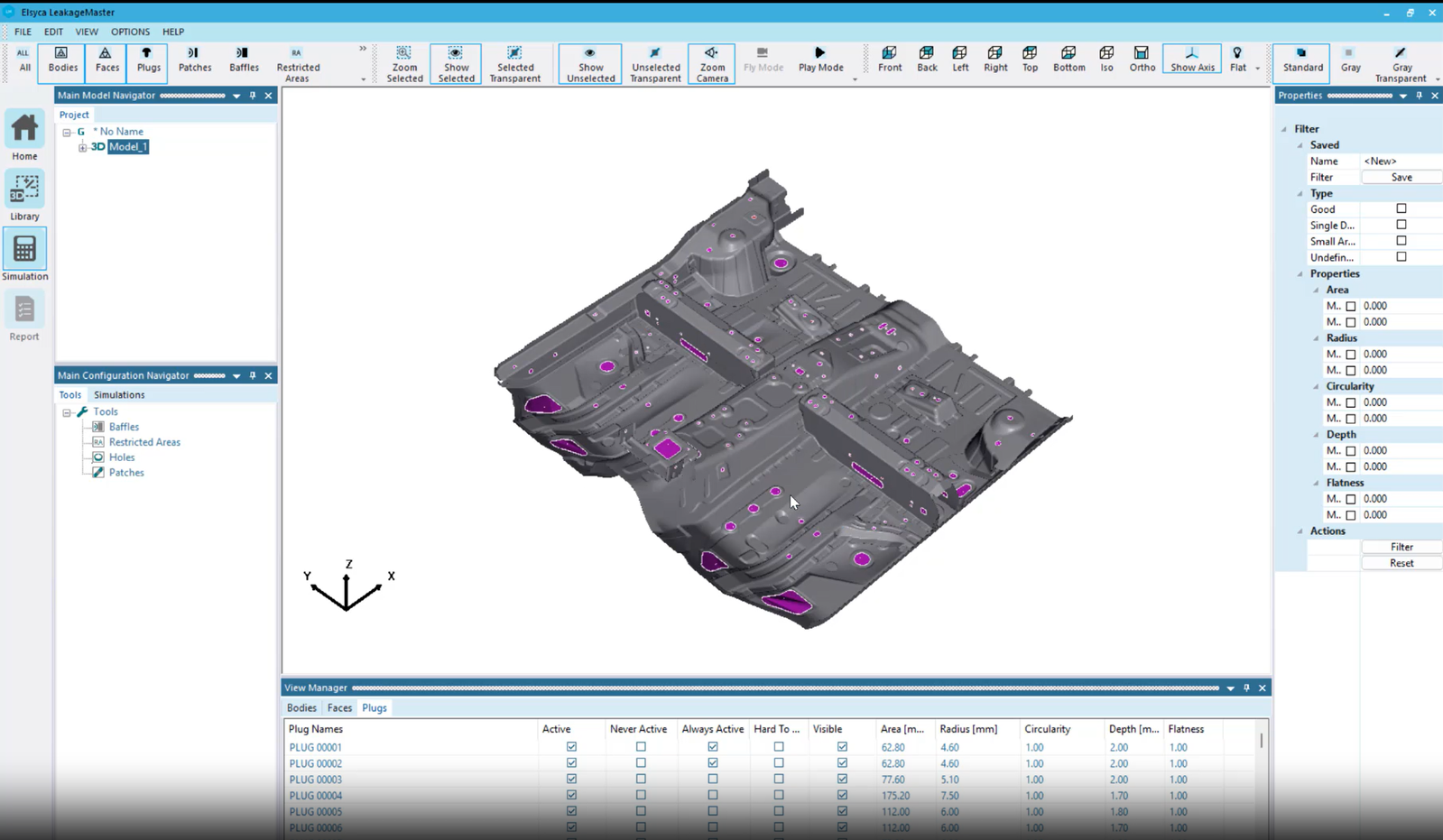
Engineers can now point LeakageMaster at other assemblies, such as bolts, nuts, or cables, provided as STL files, and the software automatically marks the plugs those assemblies close as "Always Active." Auto-generated plugs previously treated every hole as open even when it was sealed by adjacent geometry, requiring engineers to identify those cases by hand. Intersected plugs let the software mark every plug closed by surrounding geometry in a few clicks, with a paired output for validation.
A Single Metric for Sealing Performance
The release introduces Virtual Leakage Area, an automatically computed equivalent open area calculated as the sum of the smallest plug cross-section along each leakage path. Sealing performance has historically been difficult to judge and to compare across design revisions. Virtual Leakage Area gives engineers one number to quantify sealing early, track it across iterations, and catch leakage issues before committing to a physical prototype.
Seeing the Leak: Virtual Smoke Visualization
LeakageMaster can now animate particles traveling from source to receiver along each computed leakage path, reproducing the intuition of a physical smoke test without needing a prototype or a static, cluttered plot. Engineers create the vehicle model, run a simulation with the new solver, and export the results to activate smoke visualization in Elsyca XPlorer, giving an at-a-glance view of where and how a vehicle leaks.
Volkswagen, whose collaboration with Elsyca gave rise to the underlying virtual fog test approach, has used the technology to identify conceptual errors from CAD data and evaluate countermeasures early in the vehicle development process. "The result is a software-based analysis of the geometric body structure without costly physical approaches to identify possible leakage," said Knut Raffel of Volkswagen AG's acoustic department.
Availability
These capabilities are available now in LeakageMaster, effective since Release V2026.
About Elsyca
Elsyca provides electrochemical simulation and digital twin software, enabling engineers to design, analyze, and optimize surface treatment and corrosion protection processes. Its solutions serve companies across the automotive, aerospace, energy, and electronics industries, spanning applications from functional and decorative plating to cathodic protection and electrochemical machining. Through predictive simulation and process digitalization, Elsyca connects product design to real-world performance. Drawing on nearly three decades of scientific expertise and field-proven results, Elsyca helps clients reduce costs, accelerate development timelines, and ensure long-term surface integrity.